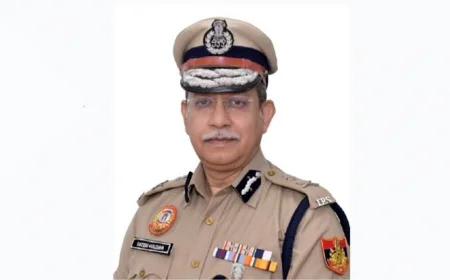



Alok Kumar Mittal Appointed Director General, BPR&D
Alok Kumar Mittal, a 1993-batch Haryana cadre IPS officer, is appointed Director General of BPR&D, with tenure running until his 2029 superannuation date.


Alok Kumar Mittal, a 1993-batch IPS officer of the Haryana cadre, has been appointed Director General of the Bureau of Police Research and Development (BPR&D), with tenure extending until June 30, 2029, the date of his superannuation.
BPR&D functions under the Ministry of Home Affairs and serves as the principal research and training coordination body for police forces across India, working on modernisation of police equipment, forensic science standards, correctional administration reforms and training curricula for state police academies. The organisation also runs the Central Detective Training Institutes and coordinates policy inputs on police reforms sought by state governments and the Centre.
As a 1993-batch officer, Mittal brings three decades of service within the Haryana cadre to the assignment, at a time when BPR&D has been pushing state police forces toward standardised forensic protocols following the rollout of new criminal justice codes. The appointment gives Mittal a multi-year runway to shape the bureau's research agenda, with his tenure running until his retirement date rather than a fixed term typical of some central deputation postings.
The Director General's post at BPR&D has taken on added significance as states implement the Bharatiya Nyaya Sanhita and related criminal law reforms, which require closer coordination between forensic infrastructure, training modules and state police departments than earlier frameworks. Mittal will be expected to oversee this transition from the bureau's research and standard-setting end.
BPR&D also functions as the nodal body advising the Home Ministry on modernisation grants to state police forces, covering equipment upgrades, forensic laboratory expansion and correctional facility reforms that states routinely draw upon. A Director General with a multi-year tenure, rather than one nearing retirement within months of taking charge, is typically better placed to see through longer research and training initiatives that span several budget cycles, a factor the Home Ministry is understood to weigh in such appointments.
The appointment was formalised through an official order confirming his posting up to the date of superannuation.