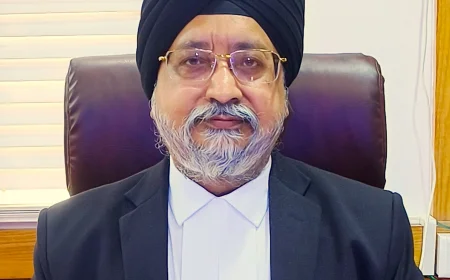



Justice Rohit Kapoor Elevated as Permanent Judge of Punjab and Haryana High Court


The legal fraternity and the judicial administration of Northern India recently witnessed a significant administrative development as the Central Government officially notified the appointment of Justice Rohit Kapoor as a permanent Judge of the Punjab and Haryana High Court. Previously serving as an Additional Judge, his elevation comes as a testament to his consistent performance, legal acumen, and steadfast commitment to the principles of constitutional jurisprudence. This transition is not merely a change in nomenclature but represents a strengthened capacity for the High Court to address its burgeoning caseload and uphold the rule of law.
Justice Kapoor’s journey to the bench is characterized by a deep-rooted understanding of civil and criminal litigation. Before his elevation, he commanded significant respect within the legal circles for his methodical approach to complex litigation and his ability to synthesize intricate legal arguments. As an Additional Judge, he presided over a diverse array of matters, ranging from service law disputes to criminal appeals, consistently demonstrating a balanced perspective that prioritized judicial efficiency without compromising the rigor of legal scrutiny.
The Significance of Judicial Appointments
The appointment of permanent judges is a critical mechanism for ensuring the stability and continuity of the higher judiciary. In the context of the Punjab and Haryana High Court, which serves two of India’s most industrially and agriculturally vibrant states, the role of a Judge is exceptionally demanding. The court frequently handles matters of immense public interest, constitutional interpretation, and administrative oversight. The confirmation of Justice Kapoor reinforces the institutional strength of the bench, allowing for the expedited resolution of cases that impact the lives of millions of citizens across the region.
The Process of Elevation
The elevation process within the Indian judiciary is a meticulous exercise involving the Collegium system. The recommendation for Justice Kapoor’s appointment was made after a comprehensive evaluation of his judicial work, integrity, and overall contribution to the court during his tenure as an Additional Judge. This rigorous vetting process ensures that only those with proven merit and an unblemished record ascend to permanent positions. The Ministry of Law and Justice, acting upon the recommendation of the Supreme Court Collegium, has effectively validated the trust placed in Justice Kapoor’s capabilities.
Looking Ahead
As Justice Kapoor assumes his permanent role, the legal community anticipates a continued focus on judicial reforms and the reduction of pendency. His elevation is viewed as a positive step toward ensuring that the High Court remains a robust guardian of individual rights and institutional integrity. His presence on the bench is expected to bring consistency to the judicial process, particularly in matters involving the interpretation of state-specific statutes and the implementation of federal mandates. The appointment signifies a commitment to maintaining the high standards of the Punjab and Haryana High Court, an institution renowned for its intellectual rigor and historical significance in the Indian legal landscape. Justice Kapoor’s career trajectory serves as an inspiration for aspiring jurists and advocates who aim to contribute to the nation’s legal framework through dedication, patience, and unwavering adherence to the law.