








Blue Economy Revolution: Maharashtra Sets Sail to Become a Global Shipbuilding Hub
In a move set to redefine the industrial landscape of India’s western coastline, the Mumbai Port Authority (MbPA) and the Government of Maharashtra (GoM) have finalized a landmark partnership to establish a National Mega Shipbuilding Cluster. This ambitious project, aligned with the Maritime India Vision 2030 and the Maritime Amrit Kaal Vision 2047, aims to propel India into the top five shipbuilding nations globally by the centenary of its independence.

In a move set to redefine the industrial landscape of India’s western coastline, the Mumbai Port Authority (MbPA) and the Government of Maharashtra (GoM) have finalized a landmark partnership to establish a National Mega Shipbuilding Cluster. This ambitious project, aligned with the Maritime India Vision 2030 and the Maritime Amrit Kaal Vision 2047, aims to propel India into the top five shipbuilding nations globally by the centenary of its independence.
A Vision for 2047: Building the Blue Economy
The collaboration is not merely an industrial expansion but a strategic mission to achieve maritime self-reliance. Under the guidance of the Ministry of Ports, Shipping and Waterways (MoPSW), the project envisions Maharashtra as an internationally competitive hub for commercial shipyards and ancillary industries.
"This cluster will augment and strengthen Maharashtra’s maritime ecosystem, elevating it into a comprehensive global maritime destination," noted a senior official during the preliminary planning stages. The initiative focuses on the development of common infrastructure—both land-side and sea-side—to fast-track the establishment of global-standard shipyards.
The Strategic Locations: Transforming the Konkan Coast
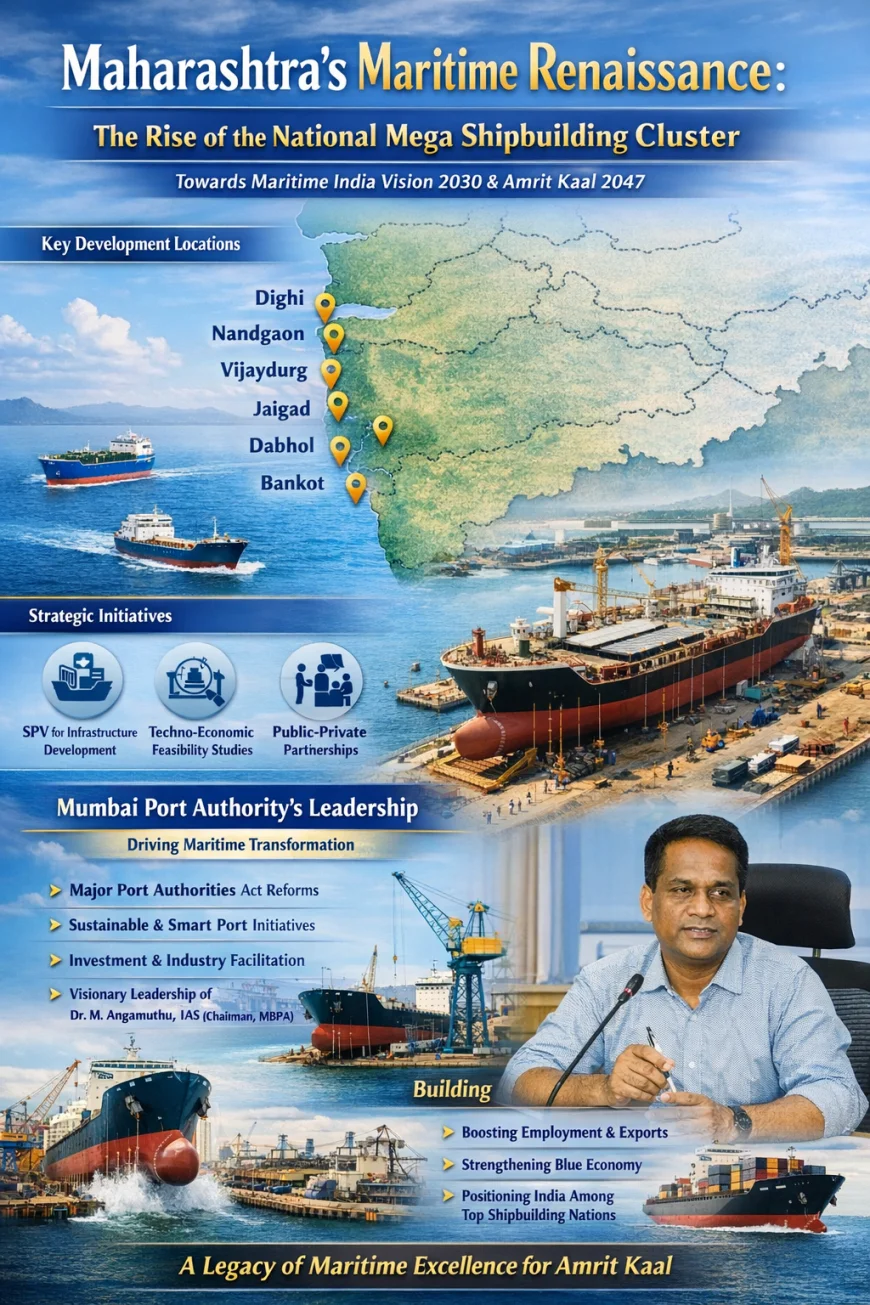
The joint venture has initially identified several high-potential locations along the Maharashtra coastline for these mega-clusters:
Dighi (Raigad): Earmarked for approximately 2,550 acres of development.
Nandgaon (Palghar): Projected as the largest site, spanning 2,666 acres.
Vijaydurg (Sindhudurg): Planned for 1,371 acres.
Other Potential Sites: Jaigad, Dabhol, and Bankot have also been identified for future phases of development.
These sites were chosen for their natural depth and strategic proximity to existing maritime traffic. For instance, Dighi offers a natural depth of 9 meters, which can be dredged to 14 meters to accommodate next-generation vessels.
The Power of Partnership: The New SPV Structure
The execution of this mega-project will be handled by a newly constituted Special Purpose Vehicle (SPV), where the Department of Transport and Ports (GoM) and the Mumbai Port Authority will be equal equity partners. This 50:50 joint venture ensures a balanced contribution from both the Central and State governments.
Governance and Management
According to official directives from the MoPSW, the SPV’s governance is designed for high-level oversight and professional management:
Chairperson of the Board: The Chairperson of the concerned Port Authority (MbPA) will lead the Board of Directors.
Director (Finance): The Financial Adviser of the Port Authority is nominated to this critical role.
Managing Director: To be nominated by the Government of Maharashtra.
Manpower: Responsibility for providing necessary manpower will be shared jointly by the State Maritime Board and the Major Port Authority.
The SPV is mandated to be formed within three months of the signing of the Memorandum of Understanding (MoU), with nodal officers appointed to facilitate swift execution.
The Landlord Model: A Catalyst for Private Investment
The project will operate on a "Landlord Model," where the SPV develops common infrastructure and subsequently leases plots to private shipbuilders and ancillary units. This approach minimizes the entry barriers for global shipbuilders.
Division of Infrastructure Development:
Sea-side Infrastructure: Managed by the representative bodies of MoPSW (including MbPA), this includes capital dredging, construction of breakwaters, and navigational aids.
Land-side Infrastructure: Managed by the Department of Transport and Ports (GoM), this includes land acquisition, internal roads, power connectivity, water supply, and drainage systems.
This division of labor ensures that the state focuses on regional development and logistics, while the central authority leverages its maritime expertise to manage deep-sea access.
Economic Impact: 40,000 Jobs and Global Competitiveness
The scale of the projected achievements is staggering. By 2030, the shipbuilding clusters are expected to:
Attract investments exceeding ₹6,600 crore.
Create nearly 40,000 direct and indirect jobs in the region.
Achieve an annual shipbuilding capacity of 1.0 to 1.2 million Gross Tonnage (GT).
Beyond just building ships, the clusters will house a complete maritime ecosystem, including:
Ancillary Industries: Units for manufacturing ship engines, electronics, and specialized steel.
Ship Repair and Recycling: Modern dry docks for maintenance and sustainable recycling facilities.
R&D and Training: Dedicated centers for maritime research and skill development to create a future-ready workforce.
Policy Incentives and Support
To ensure the success of the clusters, the government has integrated several financial and regulatory incentives:
Shipbuilding Financial Assistance Policy (SBFAS): Central support for Indian shipyards.
State Capital Subsidy: Under Maharashtra’s 2025 Shipbuilding Policy, projects can receive a capital subsidy of 15%.
R&D and Skill Grants: Support of up to ₹25 crore for research and ₹1 crore per project for skill development.
Concessional Land: Land will be provided on renewable 30-year leases to long-term investors.
Roadmap to Execution
The path forward is clearly defined. The Mumbai Port Authority will share 50% of the cost for the Techno-Economic Feasibility Report (TEFR). A consultant will be appointed to conduct these studies for Nandgaon, Dighi, and Vijaydurg, with a Detailed Project Report (DPR) for the selected first cluster expected within six months of the feasibility findings.
As Maharashtra embarks on this journey, the joint efforts of the MbPA and MMB signify a new era of cooperative federalism focused on economic growth. By transforming its vast coastline into a high-tech industrial hub, Maharashtra is not just building ships—it is building the future of global maritime trade.